One platform for requirements, architecture, tests, risk and SBOM

Retire the stack.
Keep the thread.

TraceUnified unifies the entire development and verification lifecycle — requirements, architecture, tests, risk, and connected SBOM — in a single traceability graph. Change one artifact and every linked item flags for re-verification, automatically. License all five modules, or just the one you need today.

Click Analyze on a requirement and AI checks it — gaps, conflicts, weak verifiability — and proposes a rewrite, on a model you bring. It proposes; you decide. It never touches your traceability.

  • Start with one module
  • E-signature is optional, per workflow
  • Cloud or self-hosted
  • Part 11 & audit trail when you need them

Start free in a populated, industry-specific workspace — not an empty shell. yourteam.traceunified.com

The problem

Your traceability lives in the gaps between four tools.

Requirements in one system, architecture in another, tests in a third, risk and SBOM somewhere else. The trace between them is a spreadsheet someone rebuilds by hand before every audit — and every boundary between two tools is a seam where the thread quietly breaks. The broken link is exactly what an auditor finds.

Requirements
in Jama / DOORS
Architecture
in Cameo
Tests
in TestRail
Risk & SBOM
in another tool

Each tool owns one link in the chain. None of them owns the whole thread.

How it works

Five core modules, connected by traceability. One system of record.

Requirements, architecture, tests, risk and SBOM are linked records on one model. Review, approval, versioning, training, audit, reporting, import and release work the same on every module — and a governed AI assistant reads across the whole connected model: it proposes, you decide, on a model you bring, and never edits the record.

Traceability between modules AI reads across the model Available on every module Change → re-verify
Click any core module to see what a change makes suspect across the connected model.
On every module
Tap a module to see what a change makes suspect across the connected model.
On every module
Platform

The platform

Five disciplines. One model. Masters of each, unified.

Each pillar is a real, deep capability — not a thin module. What no point tool can offer is the connection between them: it's the same data, so the thread is intrinsic.

Requirements

Requirements that carry their own rules

Author, version, and baseline requirements as governed items. Relationship rules define what may link to what, so the trace model is enforced — not left to convention. Optional AI flags ambiguous or untestable language as you write.

REQ-014verified by REQ-014mitigated by REQ-014baselined v3
Architecture

SysML models linked to the same items

Activity diagrams, allocation and satisfy/verify matrices, and model validation — with elements trace-linked to requirements and tests in one database. No ReqIF round-trip, no drifting copies.

TC-220
TC-221
TC-222
BLK-07
BLK-08
Test execution

Plans, runs, milestones, re-verification

Build test plans, execute runs with pass / fail / blocked steps, track milestones, and log defects from failed results — each linked back to the requirement it verifies.

Pass 64%Fail 14%Blocked 10%
Milestone · V&V Build 2.4
Risk

Risk scored and mitigated, in the thread

Score risks, link mitigations to requirements and tests, and surface residual risk. When a mitigation changes upstream, the linked risk flags for review.

RISK-07 · residual: medium
SBOM

CycloneDX and SPDX, mapped to your model

Import CycloneDX and SPDX bills of materials, reconcile components by package URL, and track vulnerabilities against the components your product actually ships.

libcrypto3.0.120 CVE zlib1.2.132 CVE curl8.4.00 CVE

Scope & licensing

Take one module. Or all five.

TraceUnified is licensed per module. If requirements are all you need, license Requirements — nothing else appears, and nothing else is billed. Add tests, risk, architecture, or SBOM when the work asks for them. Two engineers or two hundred; the platform doesn't care how big the project is.

Requirements
Author, version, baseline, trace
license on its own
Tests
Plans, runs, defects, coverage
license on its own
Risk
Score, mitigate, residual risk
license on its own
Architecture
SysML models, allocation matrices
license on its own
SBOM
CycloneDX / SPDX, vulnerabilities
license on its own

Included with any license, however few modules you take:

TraceabilityReviewsReleasesReportsDashboardsNotifications

Taking several? Core (Requirements + Tests), Professional (+ Risk) and Enterprise (+ Architecture) bundle them at a lower rate than buying each alone. See how licensing works →

Compliance is a switch, not a toll gate.

Signatures, approvals and controlled states are configuration. Electronic signature is a checkbox on a workflow, and it ships off — turn it on for the workflows that need it, and only those.

Normal project Controlled project
Traceability & impact analysis On On
Versions & change history On On
Reviews & comments On On
Electronic signature Off On
Approval chains Off On
Controlled states & locks Off On

Same data, same graph, same tool. The team shipping a consumer app runs the left column and never sees a signature dialog. The team filing a 510(k) turns the right column on — and because the history was there all along, the evidence is already written.

See it in action

Take a look inside.

TraceUnified Workspace view
The full workspace — every module, planning, analysis, and compliance one click away, each with its own live dashboard.
TraceUnified Requirements view
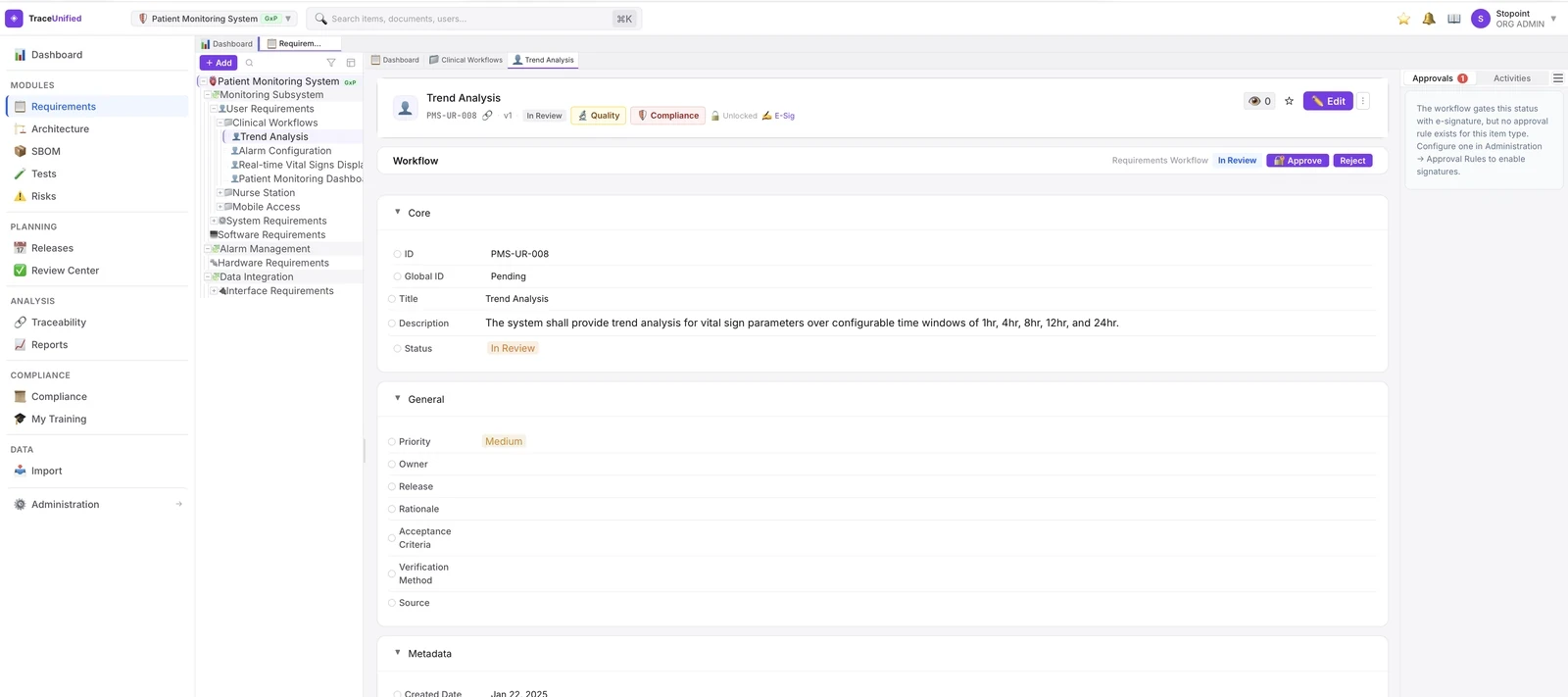
A requirement with identity, lifecycle, and quality + compliance status.
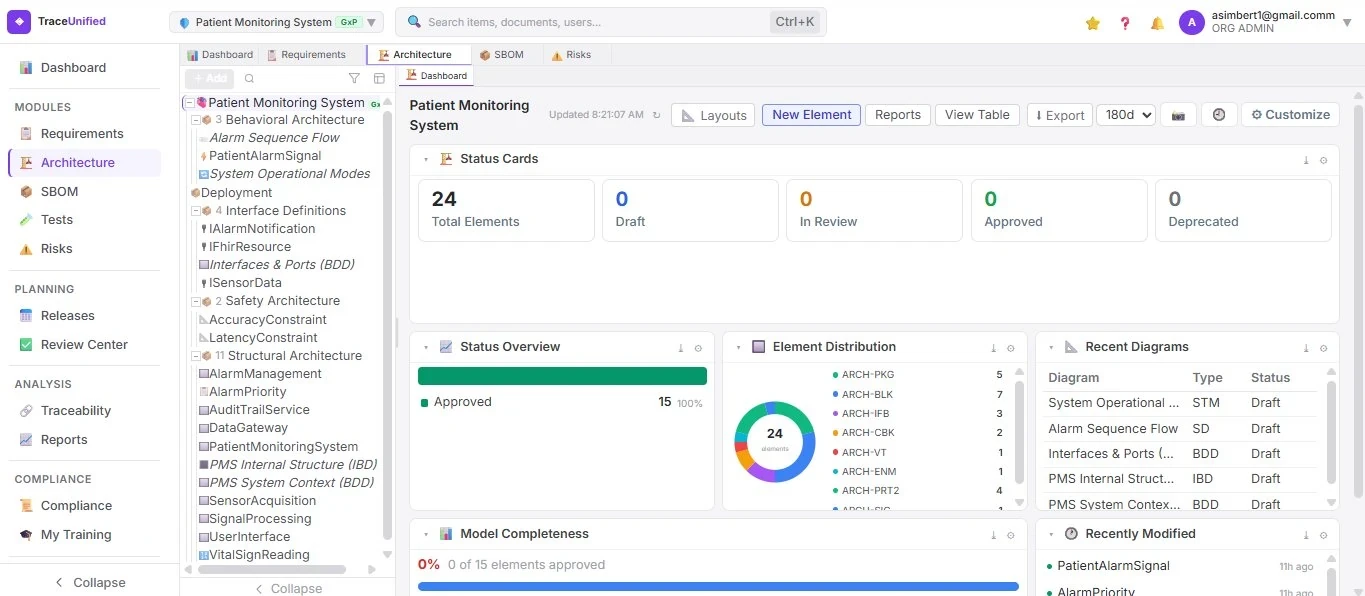
TraceUnified Architecture view
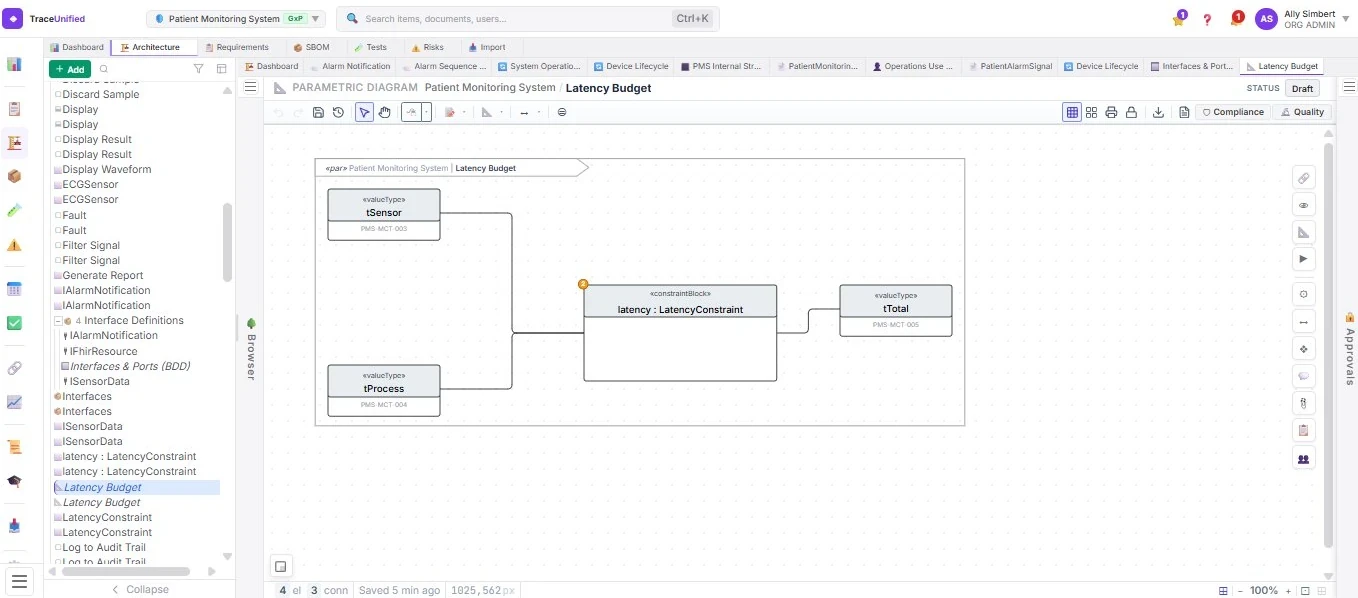
SysML parametric diagram — native MBSE.
TraceUnified Tests view
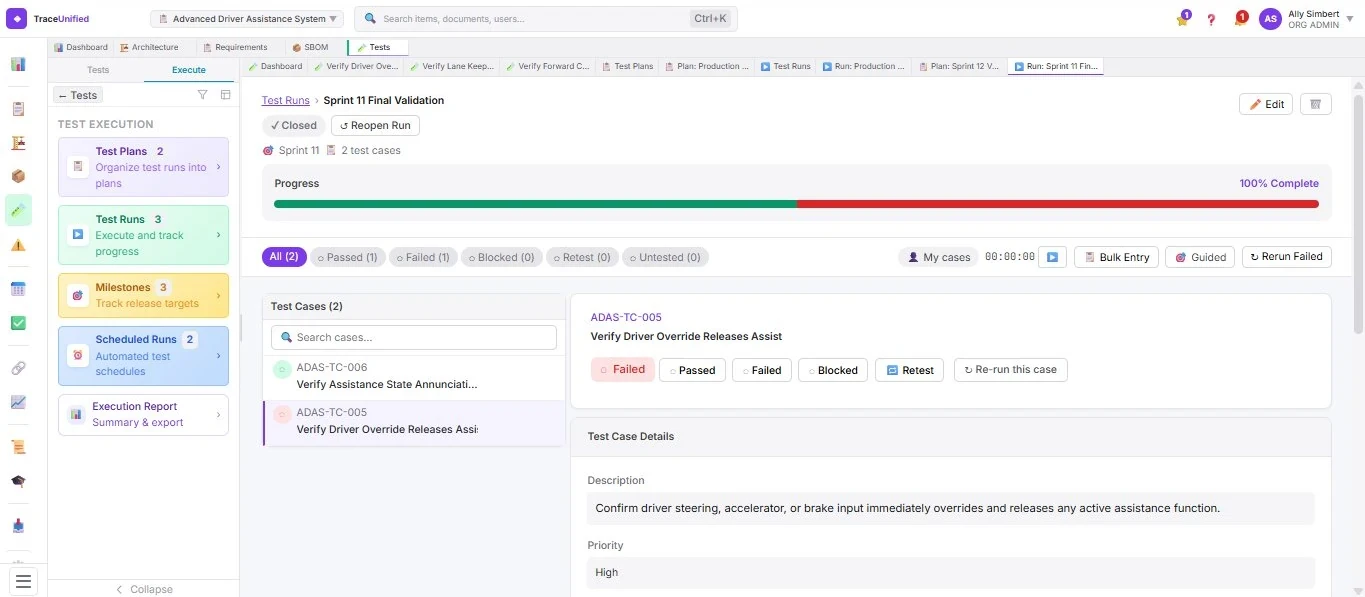
Test runs and milestones with pass/fail status.
TraceUnified Risk view
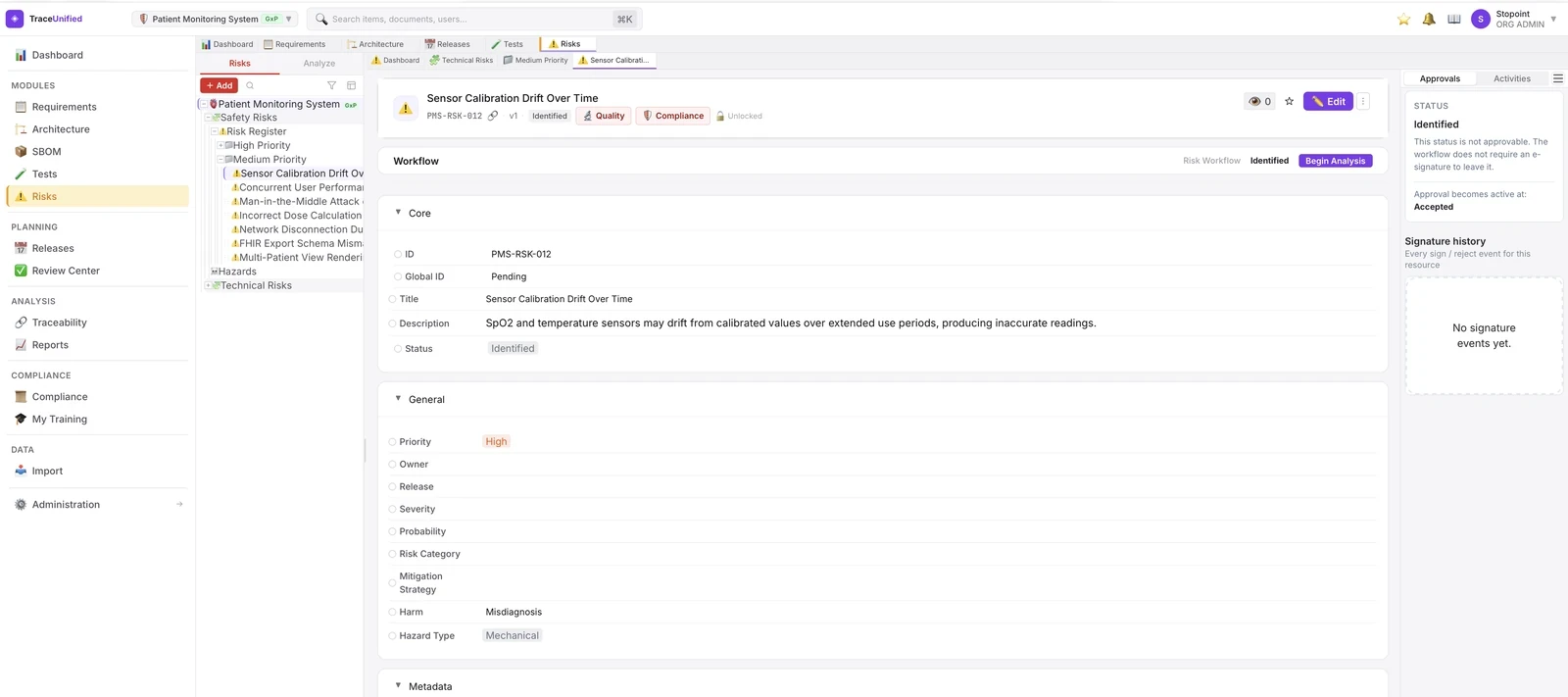
A risk with severity, mitigation status, and full lifecycle.
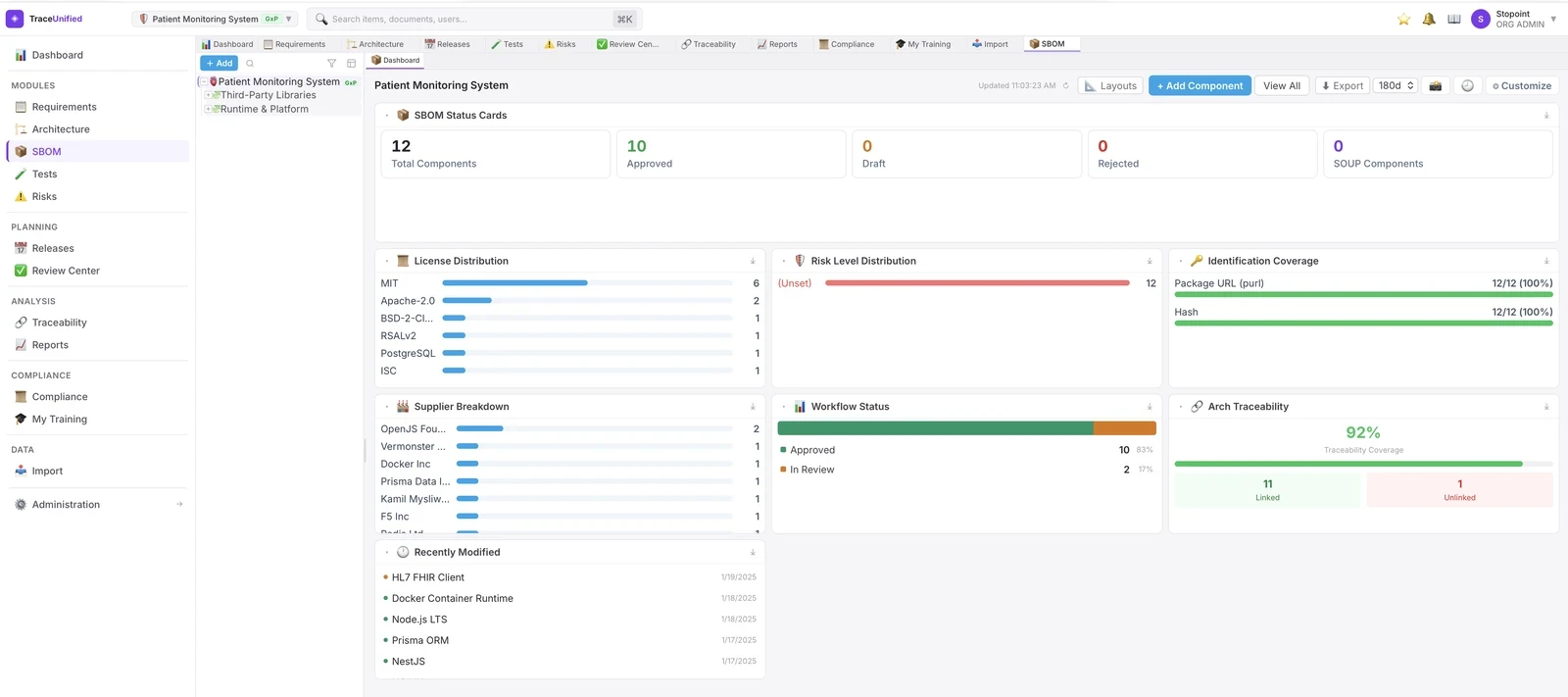
TraceUnified SBOM view
Every component tracked — licenses, supplier breakdown, identification coverage, and architecture traceability.
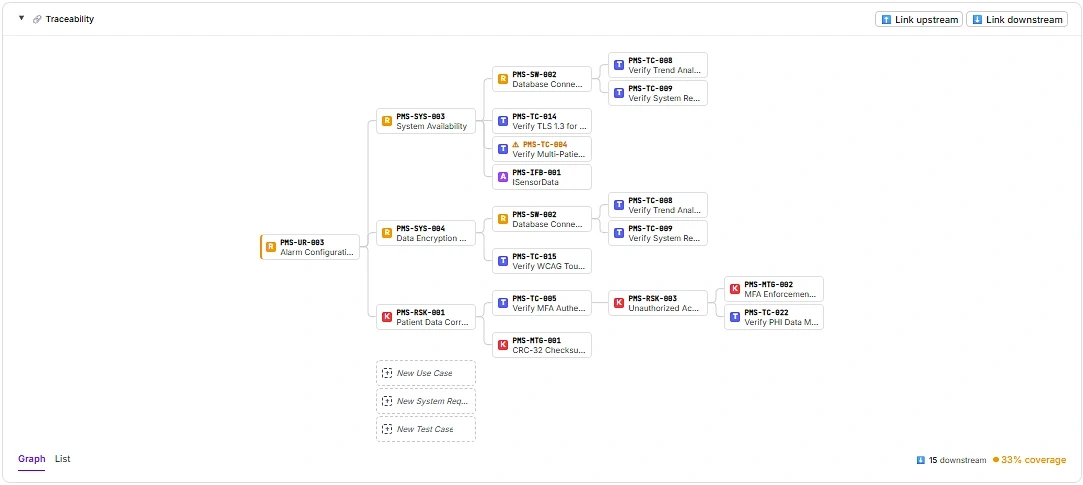
TraceUnified Traceability view
One upstream, three downstream — 100% coverage.
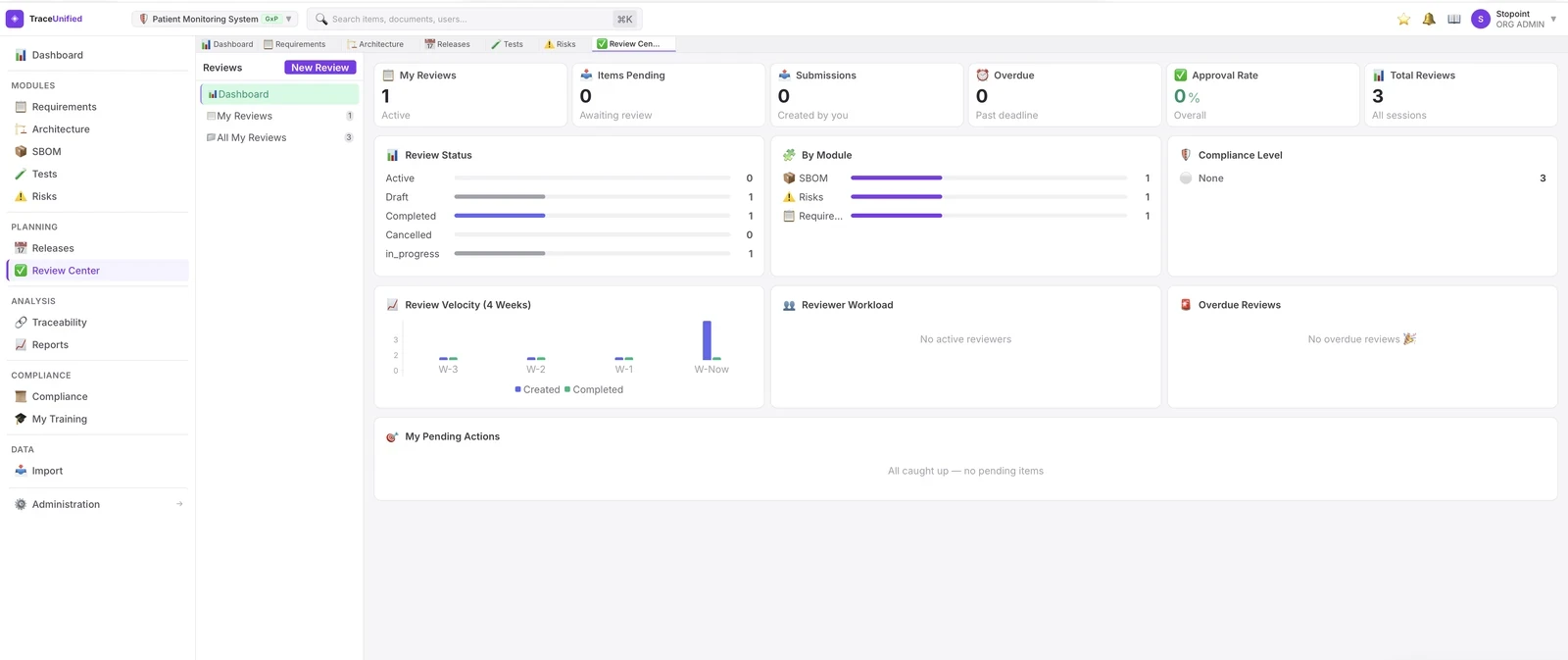
TraceUnified Review Center view
Review sessions across modules — status, velocity, and reviewer workload.
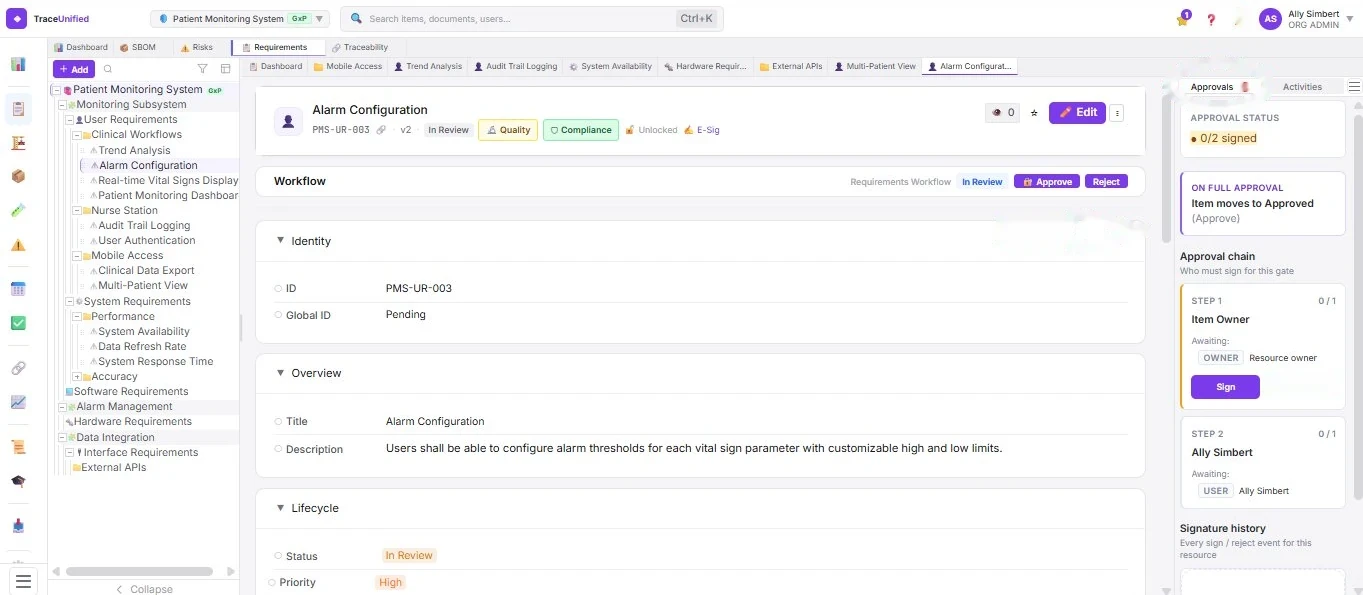
TraceUnified Approvals view
Multi-step electronic signature chain — who must sign, signature history, e-sig enforced.
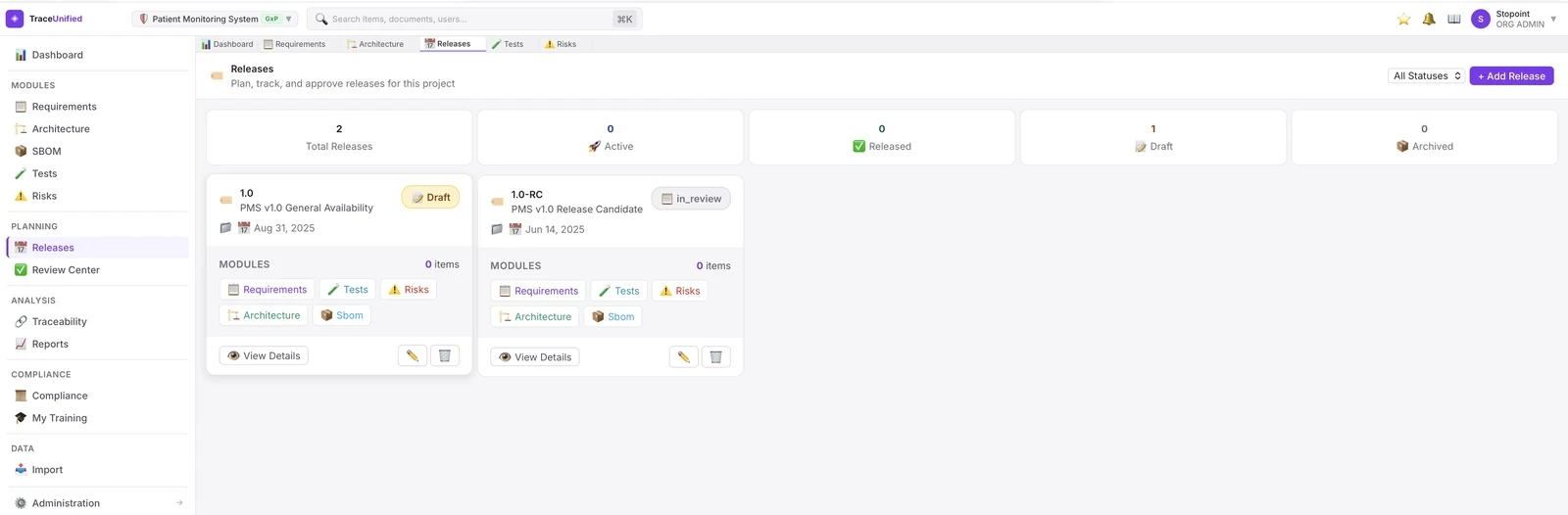
TraceUnified Releases view
Plan and approve releases — modules bundled, statuses tracked, draft through GA.
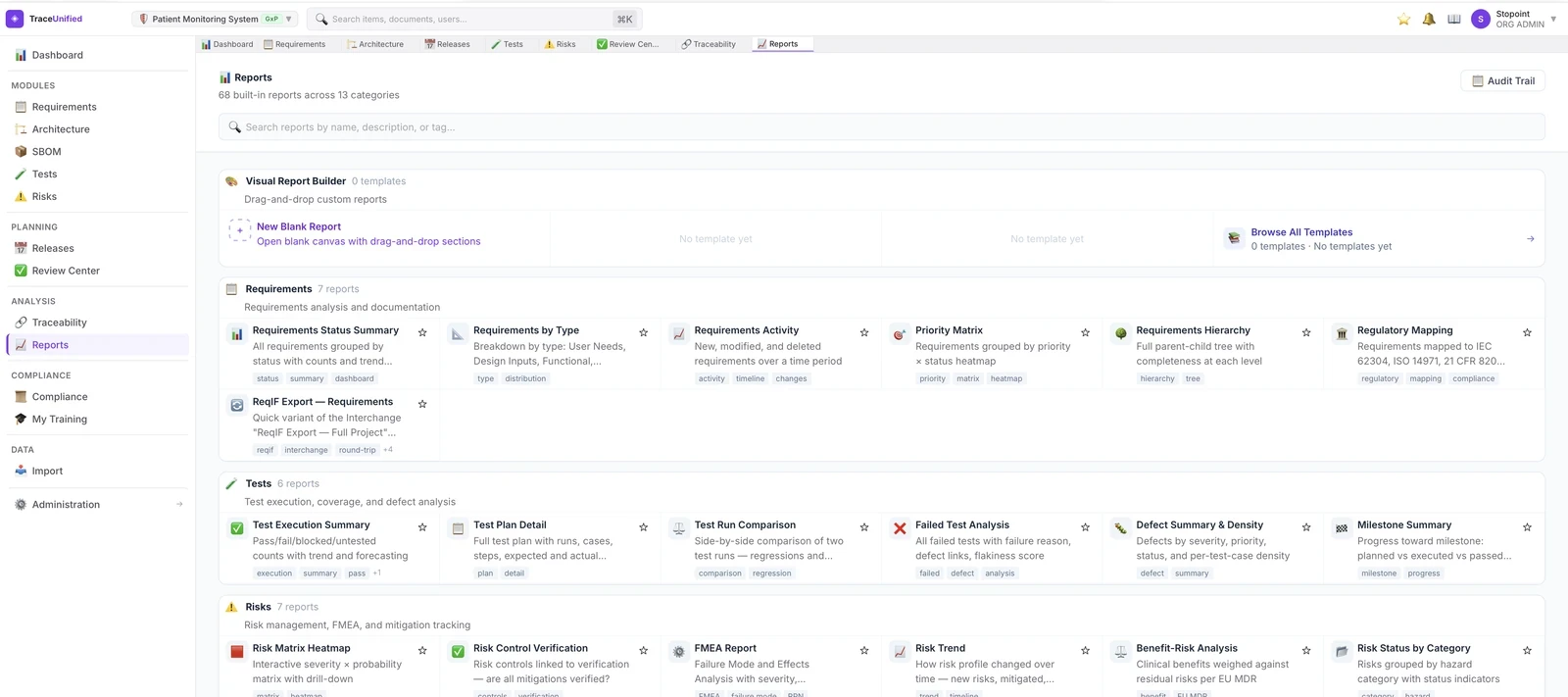
TraceUnified Reports view
68 built-in reports — regulatory mapping, FMEA, coverage, and ReqIF export.
See the full platform tour →

Ready to retire the stack?

Start free in a populated, industry-specific workspace — the whole thread, already linked. Not an empty shell.

Governed AI

AI you can turn on in a validated environment.

TraceUnified's AI is a governed advisory layer. The agents analyze and propose — they never write to your records. A human applies every change through the signed, audited workflow. AI is additive, never authoritative — the thread stays deterministic, every link still explicit and human-made.

Advisory by design
Agents surface issues and propose improvements — they never edit your records. Humans apply every change.
Fail-closed & license-gated
AI starts off at every level and cannot be enabled without an active AI license. Turning it off is always allowed.
Layered control
Org master switch, per-agent on/off, and per-project delegation — you decide exactly where AI runs.
Your key, your model
OpenAI, Azure OpenAI, Anthropic, or your own endpoint. No shared model sits over your data.

OpenAI · Azure OpenAI · Anthropic · your own endpoint

See how the governance works →

The derivation engine

Derive the whole thread from your requirements \u2014 grounded, cited, and yours to accept.

Point the engine at a set of requirements and it proposes the downstream work products they imply. Every item cites a real source; you accept what's right. The record only ever changes by human action.

Requirements Tests
Requirements Architecture
Req + Arch Risks (FMEA)
Architecture SBOM
See how derivation is governed \u2192

Connected SBOM

Your SBOM lives on the thread — not in a scanner you forgot about.

The FDA now requires a machine-readable SBOM in premarket submissions for connected devices — and can refuse one that's missing it. But a component list in a separate tool answers nothing when a CVE drops. In TraceUnified every component is a first-class item on the same trace graph as your requirements, risks, and tests — so a vulnerability flags exactly which hazards it threatens and which tests cover it.

1 upstream · 2 downstream · CVE flagged → 1 risk now suspect, re-verification required

  • CycloneDX 1.5 & SPDX 2.3 import
  • CVE / CVSS / CWE tracking
  • Native trace to risk & test
  • Suspect propagation on change

Compliance spine

Audit-ready when you need it. Never bolted on.

The controls a regulated submission depends on are part of the data model, not a plug-in — so turning them on is configuration, not a migration. Projects that don't answer to a standard leave them off and lose nothing. Projects that do switch them on and find the evidence already written.

Available on every project · enforced only where you enable it

  • Tamper-evident audit trail — every entry hash-chained to the one before it
  • Electronic signatures with required meaning-of-signature and password re-authentication
  • Baselines, locks, and release re-verification gates
  • Formal reviews with decisions, participants, and revision snapshots

One spine, configured to the standard you answer to:

21 CFR Part 11IEC 62304ISO 14971ISO 13485EU MDRISO 26262IEC 61508DO-178CIEC 62443

Industries

Built for work that has to hold together.

One traceability model. Tune it to the standard you answer to — or to no standard at all. We lead where we're sharpest, medical device, because that's the hardest version of the problem; teams with nothing to certify run the same platform with the compliance controls left off.

Strongest fit

Medical device

FDA 21 CFR Part 11 · IEC 62304 · ISO 14971

The sharpest fit — design history, V&V traceability, risk, and e-signatures in one record. Demo content ready today.

Aerospace

DO-178C

Objectives traced from requirements through verification.

Automotive

ISO 26262

Functional-safety work products linked across the lifecycle.

Industrial

IEC 61508

Safety functions traced to tests and evidence.

Semiconductor

Functional safety & traceability

One model from spec to verification.

No compliance needed

Everything else

No standard to answer to

Software, hardware, internal tools. The same traceability and the same modules — with the signatures and approvals switched off.

See it for yourself

We're new. The proof is the product, not a wall of logos.

Start a free trial and land in your own isolated workspace with a populated, industry-specific project — the whole thread, already linked. Judge it on the work.

yourteam.traceunified.com