Releases
Ship exactly what was reviewed and signed.
A release is a governed bundle of the requirements, tests, risk, architecture, and documents that make up a shippable increment — captured together, tracked from draft through general availability, and approved against the live evidence behind it.
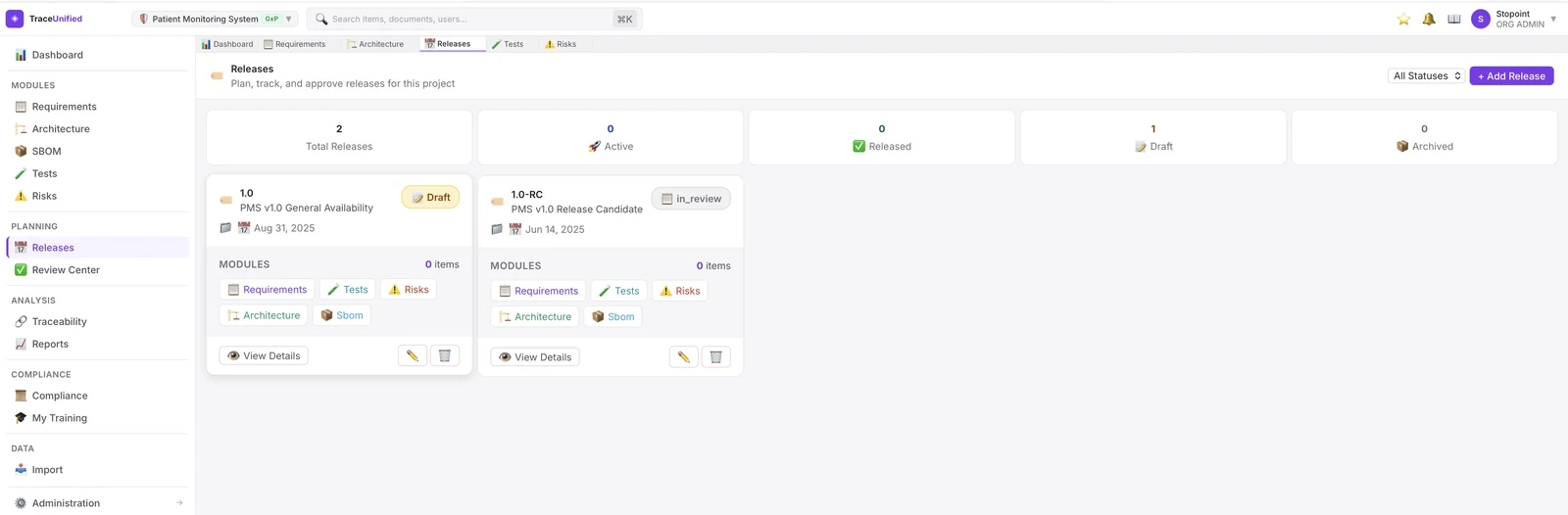
A release as a governed bundle — tracked from draft to GA and approved against the live evidence behind it.
What it does
A release is an object, not a label.
Because the bundle references the actual records rather than copies, the evidence behind a release stays live — a failing test or a suspect requirement shows honestly instead of hiding behind a green tag.
Governed bundles
Plan a release as a bundle of the exact modules and records that make up a shippable increment, reviewed and approved as one thing.
Lifecycle statuses
Draft while assembling, a controlled state under review, and general availability once approved — and those statuses gate what can change.
Approved against evidence
Take the whole package through approval against the verification results and risk posture behind it, so sign-off means something.
Live, not copied
The bundle references real records, so its state reflects what is actually true — a release under approval cannot be quietly edited out from under its reviewers.
On the thread
What shipped is what was signed.
When an inspector asks for the evidence behind a version, the release bundle is the answer — the baselined items, results, risk posture, and signatures, preserved together.
Release with evidence, not assertions.
Bundle the increment, track it through its lifecycle, and approve it against the live evidence — so what ships is provably what was reviewed.