Traceability
The thread that ties it all together.
Traceability is the core of TraceUnified. Links across every artifact are native and deterministic — human-made, not inferred — so the thread is trustworthy enough to build compliance on. Change one item and downstream links flag suspect for re-verification, with live coverage you can audit and impact analysis you can act on.
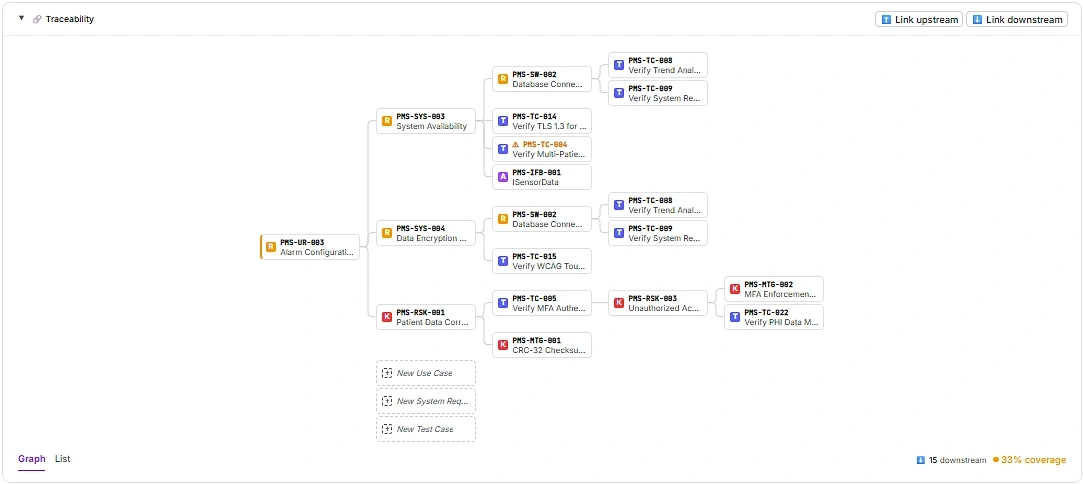
The trace matrix — deterministic links across modules, with live coverage and suspect flags you can act on.
What it does
Links that are real records, not guesses.
An inferred link can be wrong and no one would know. A deterministic link between a requirement and the test that verifies it is an explicit, auditable fact — which is what makes the thread strong enough to carry compliance.
Native, deterministic links
Relationships are deliberate, human-made connections stored as real records — typed and directional, so a link carries genuine engineering meaning.
The trace matrix
Read relationships across modules in one view, and turn the thread into a direct answer: which requirements are traced and verified, and where the gaps are.
Suspect links
When an item changes, downstream links flag suspect — marking exactly what needs re-verification instead of leaving you to guess what a change invalidated.
Impact analysis
Before you make a change, walk the thread to see what it would touch — so the blast radius of an edit is known in advance.
On the thread
Documentation becomes a safety mechanism.
Suspect propagation and impact analysis turn traceability from a record you keep into an active control that protects every change.
Trace everything. Prove anything.
Build on a thread of real, deterministic links — with live coverage, suspect flags, and impact analysis that make change safe.