Risk
Risk assessed in context, never in isolation.
Built on the ISO 14971 model, risk registers carry severity, probability, priority, and mitigation status — and each risk links to the requirements, tests, and components it touches, so the impact of a design change on your risk picture is always visible.
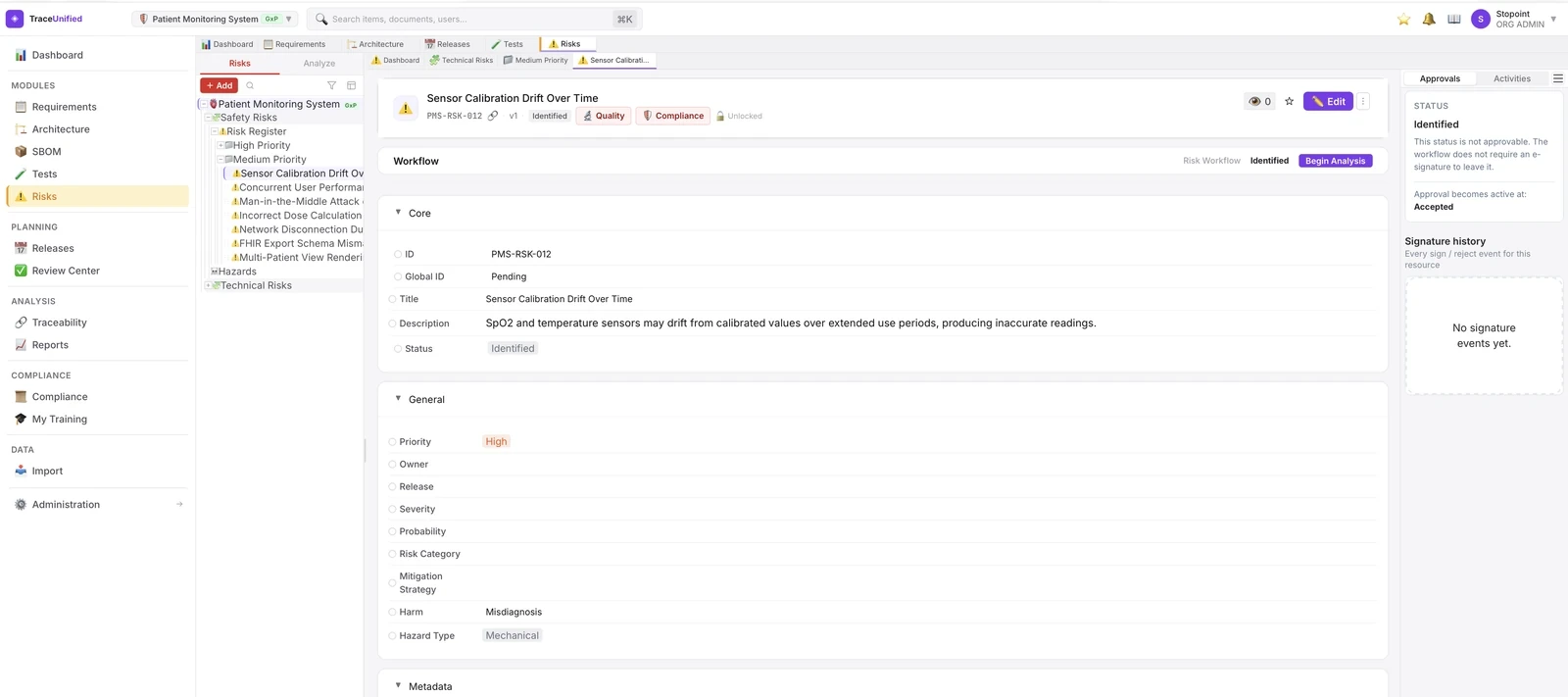
A risk register on the ISO 14971 model — scored, linked to the requirements and components it touches, and tracked to acceptable residual risk.
What it does
A register that stays connected to the design.
A risk register kept in a spreadsheet drifts from the design the moment either changes. Here, risk is part of the same connected record as the work that creates and mitigates it.
ISO 14971 registers
Registers carry the dimensions regulated risk management needs — severity, probability, resulting priority, and mitigation status.
Scoring, matrices & FMEA
Scoring supports the risk matrix and FMEA-style analysis, so the method matches how your quality system expects hazards to be evaluated.
Mitigations tracked
Mitigations capture the controls you introduce and track their status, linked to the requirements and tests that address the hazard.
Residual risk & ALARP
The ALARP and residual-risk view makes the final judgment explicit — what risk remains after mitigation, and the reasoned basis on which it is accepted.
On the thread
The impact of a change, always visible.
Because scores live on linked records, a change that raises a hazard’s severity is connected to the requirements and tests that address it.
Requirements and architecture together drive the FMEA, so failure modes reflect the real design.
A component vulnerability propagates suspect status to the risks that depend on it.
Derive with AI
Derive an FMEA from requirements and architecture.
The governed derivation engine proposes failure modes as a structured FMEA from your requirements and model — it builds the structure and cites its sources, but it will not set severity, occurrence, detection, or RPN. Those numbers are yours; you assign them and accept.
Manage risk where the work lives.
Assess hazards in context, tie mitigations to the design, and drive risk to a defensible residual level — all on ISO 14971.