Requirements
Requirements as governed records.
Every requirement is a versioned, controlled item with its own identity, lifecycle, and state — scored for quality and checked for compliance as you write, not after the fact. And they are the anchor of the thread that ties your whole program together.
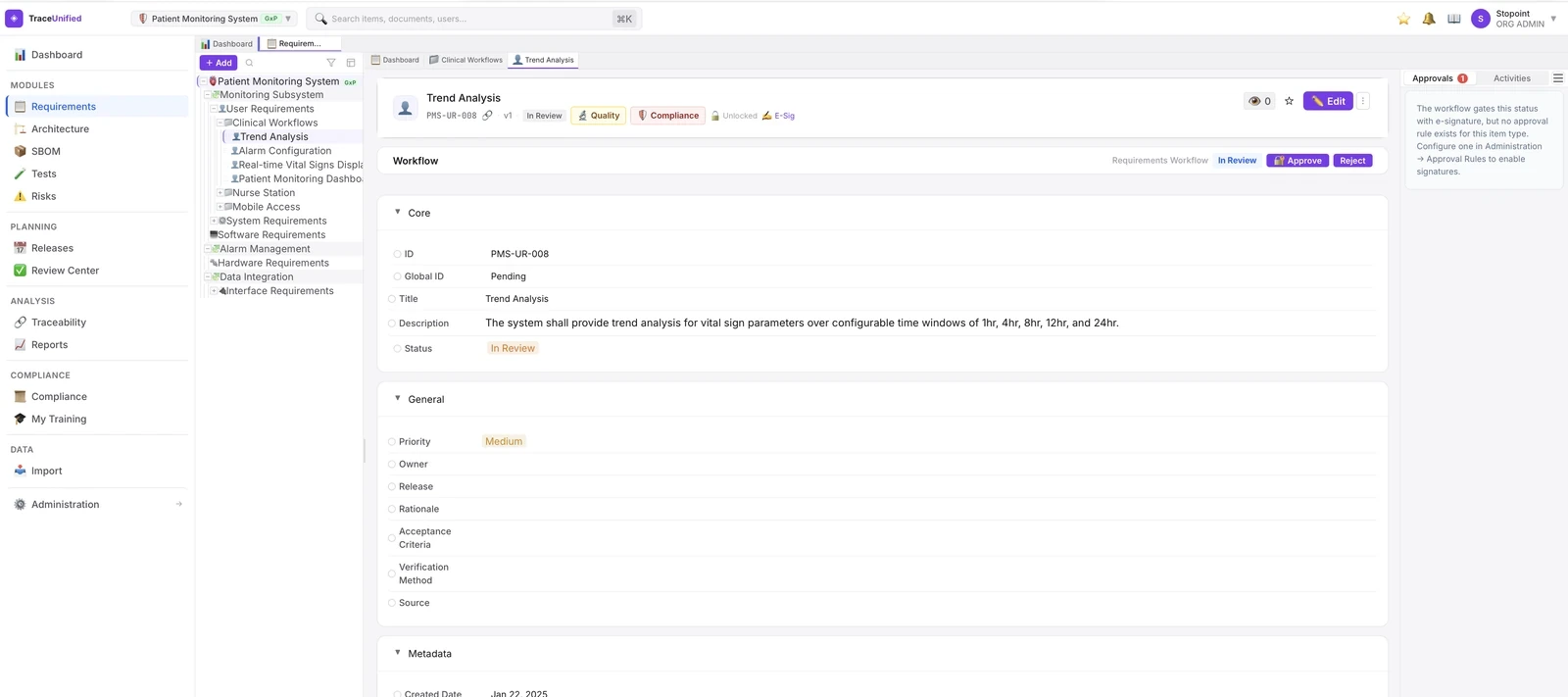
The requirement workbench — identity, workflow state, quality and compliance checks, and every field in one controlled record.
What it does
Written under control, measured, and checked.
A requirement is not a row of text. It is a controlled record — and three kinds of governance keep it trustworthy from the first draft.
Lifecycle & states
Draft, review, approved, and beyond — each transition governed by a workflow that decides who can move a requirement, from which state, and what the move requires. A status here means something an auditor can rely on.
Quality scoring as you write
Writing quality and ALCOA+ data-integrity expectations are scored during authoring, so a weak or ambiguous requirement is caught while it is cheap to fix — not discovered downstream.
Compliance checks inline
Framework-specific rules run as you author, so the record is trustworthy by the time it is approved rather than corrected in a scramble before a submission.
Versions & history
Item types and fields give every requirement a consistent shape; versions and history capture every change, so the record’s full evolution is accountable.
On the thread
The anchor everything else connects to.
Requirements are where traceability begins. The quality of the requirement record propagates through everything linked to it.
Test cases reference the requirements they prove, so coverage and suspect status stay live.
SysML model elements trace to the requirements they realize, in the same database.
Derive with AI
Turn requirements into the rest of the thread.
Point the governed derivation engine at a set of requirements and it proposes the downstream work products they imply — grounded, cited, and yours to accept. Nothing is written until you do.
Start with requirements you can trust.
Author them under control, measure them as you write, and let the rest of your program trace back to them.