Advisor
Three reviewers on every record, before anyone signs it.
Open the Advisor beside any requirement, test, risk or component and review it three ways: Intelligence, an AI review that proposes improvements; Compliance, rule-based checks graded on your server; and Quality, a grade for how the requirement is written. None of them changes the record. A person decides, and every run is on the audit trail.
Intelligence · AI
An AI review that proposes, and never writes.
Pick an analysis agent and press Analyze item. Intelligence reads the record’s fields and comes back with a score, findings tied to the exact field they concern, and a proposed rewrite you can compare side by side. It is labelled AI-generated, and nothing changes on the record until a person acts on it.
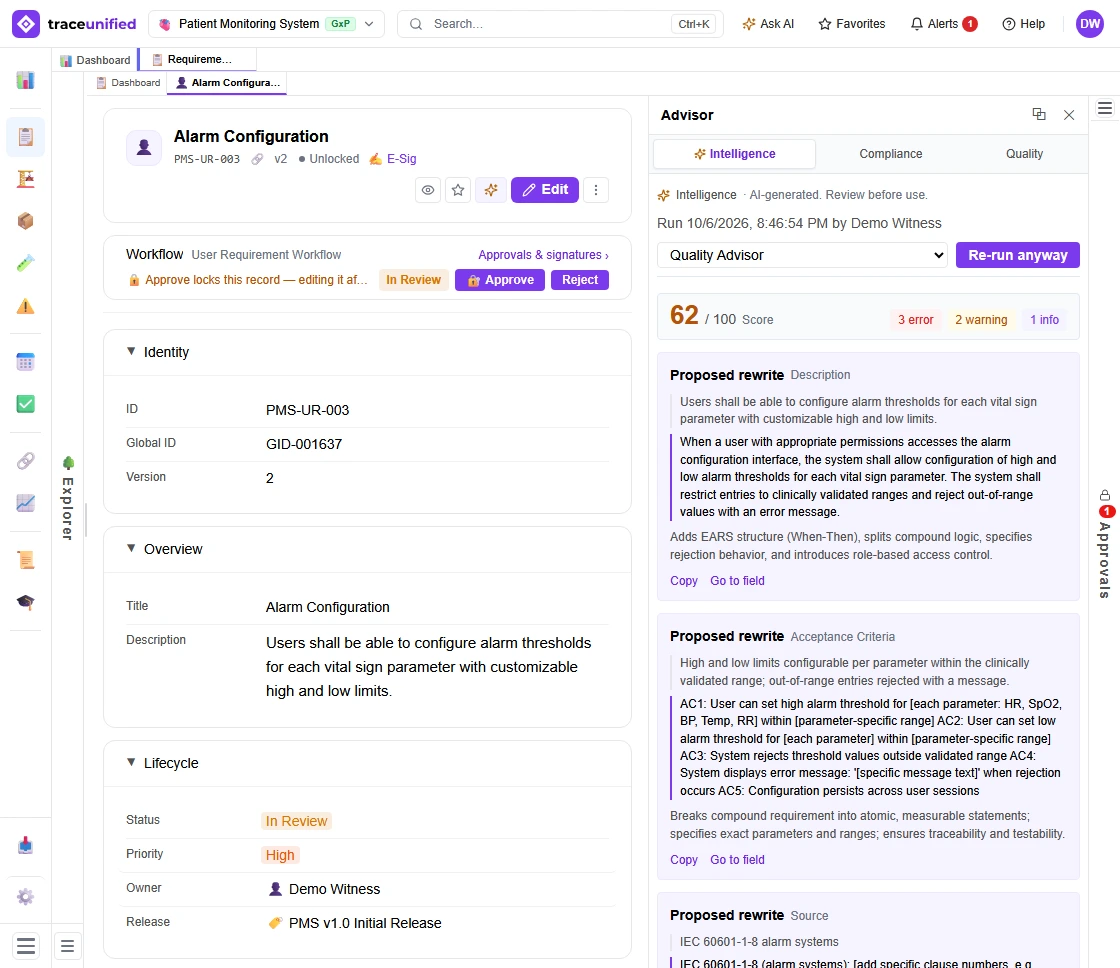
- A score out of 100 — with errors, warnings and notes counted, so you can see at a glance how far a requirement is from ready.
- Proposed rewrites — shown before and after for each field — here, an EARS When/Then form, atomic acceptance criteria, and a source cited to the clause — with Copy and Go to field.
- Choose the reviewer — Quality Advisor, Rewrite Assistant or Compliance Reviewer; your administrators decide which agents and which checks are on.
- Evidence, not a chat — every run is stamped with who ran it and when, warns you if the record has changed since, keeps its history, and is written to the audit trail. Re-running unchanged content reuses the stored result.
Compliance · rule-based
Compliance checks, graded on your server.
Compliance runs the checks your administrators have enabled for this item type, on the server. Nothing is sent to a model, so the same record gives the same verdict every time. Here it finds the two gaps an auditor would: no downstream trace, and no test that verifies the requirement.
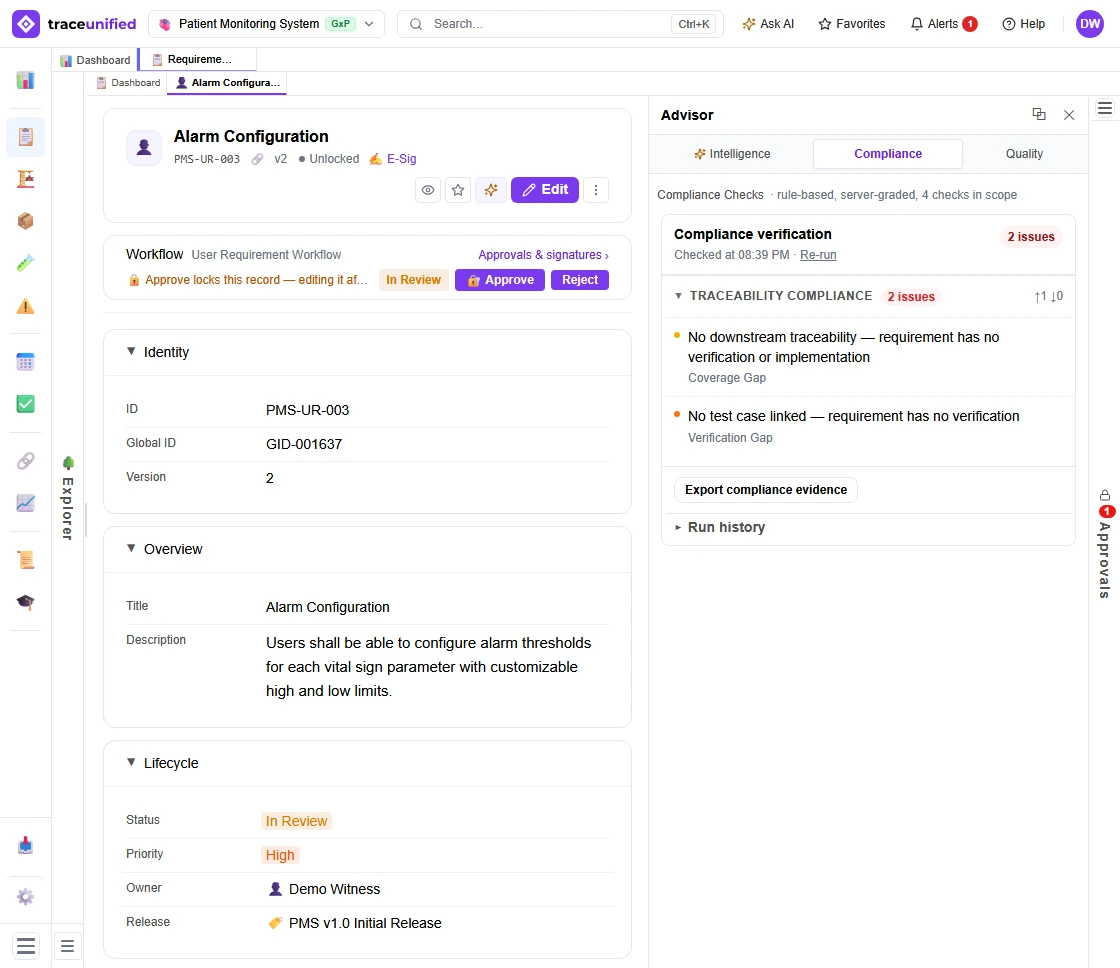
- What it checks — required fields, approvals and reviews, time spent in draft, suspect links, upstream and downstream traceability, the health of the whole trace chain, risk mitigation and residual risk, and SBOM licence and integrity.
- An honest verdict — the score is the share of in-scope checks that pass. When no check applies, it says “Not applicable” rather than calling it a pass.
- Fix in one click — where a check has a remedy, the issue carries the action — assign, set or review — so the fix is one step away from the finding.
- Evidence you can hand over — every run is stored and audited with the record’s version, and Export compliance evidence produces the report for a submission.
Quality · rule-based
Requirement quality, graded against EARS and INCOSE.
Quality reads how a requirement is written and grades it with a letter and a score out of 100, using the rule frameworks your administrators enable. Like Compliance it runs on the server and sends nothing to a model. Each finding shows the exact words it matched and what to do instead.
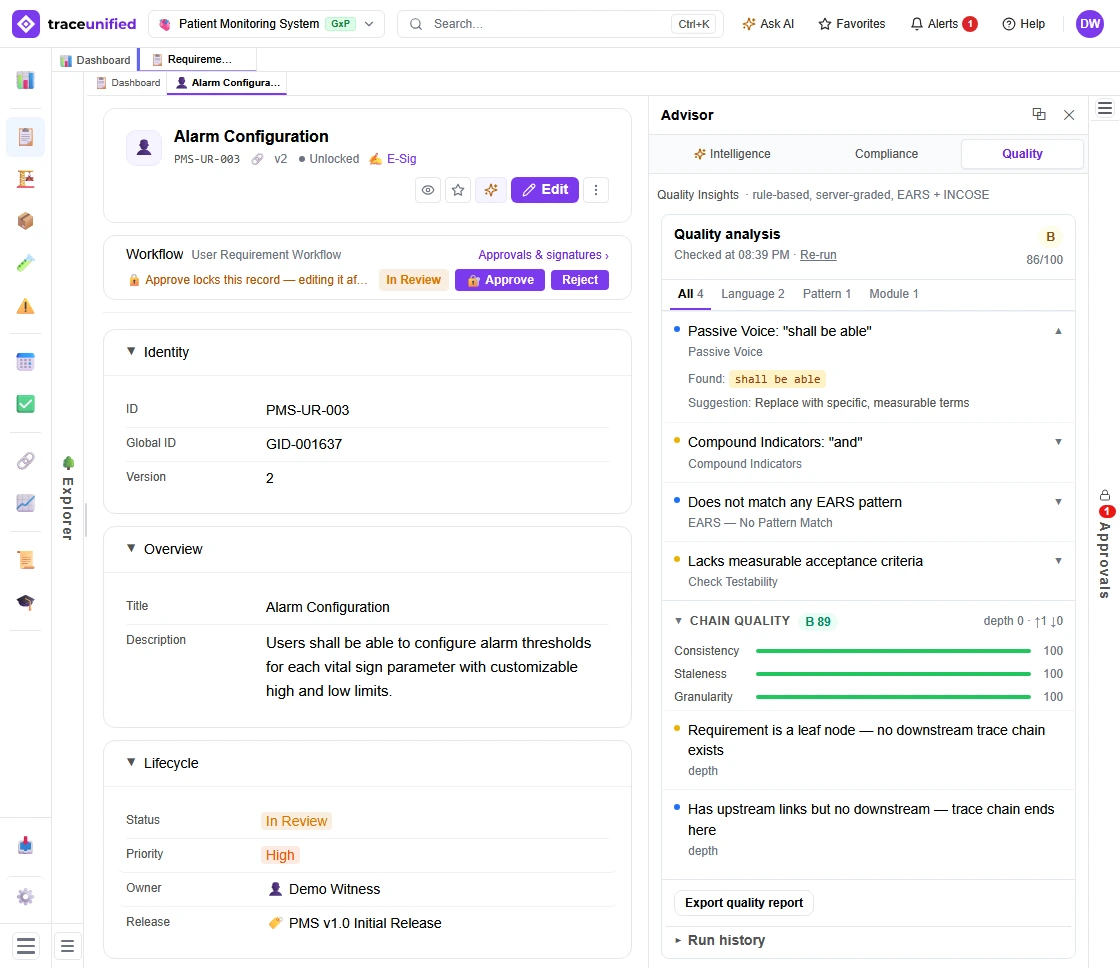
- Language — ambiguous and weak words (should, may), passive voice, compound statements and vague pronouns — each flagged with the text it found.
- Structure — whether the requirement matches an EARS pattern, the INCOSE characteristics of a good requirement, and optionally IEEE 29148 — plus any custom rules you add.
- A grade that means the same thing everywhere — the score starts at 100 and drops by a fixed amount per finding by severity; the grade thresholds, rules, severities and scope are yours to set.
- Chain quality — consistency, staleness and granularity of the trace chain around the requirement, with Export quality report for the record.
Governed by design
Advice, never action.
Findings and rewrites are proposals. The record changes only when a person edits it, through the same controlled, signed workflow as any other change.
Intelligence is labelled AI-generated on screen. Compliance and Quality are deterministic rules on your server, and send nothing to a model.
Who ran it, when, against which version of the record — stored, audited, and flagged as stale the moment the record changes.
The same three tabs open on architecture diagrams, so models are reviewed with the same rigour as the requirements they realize.